
Little Caesars Arena Information
Located at 2645 Woodward Avenue, with a capacity of 19,515 for ice hockey and 20,491 for basketball, the Little Caesars Arena is part of the District Detroit, a 50-block wide area of parks, restaurants, bars and facilities, to which it is connected by a unique concourse with a glass roof.
With buildings including the box office for the arena, the offices of the Red Wings and housing retail outlets all connected beneath this unusual glass roof, forming an indoor concourse, the Little Caesars Arena design features a truly one-of-a-kind layout. This concourse remains open all year round, enabling it to be used as a venue even when no events are going on within the arena.
The arena was opened in September 2017, costing $862.9 million to build. The venue is also known by a variety of nicknames, including “The DoughJoe”, “The Pizza Box”, “The Pizzarena”,”The Pizza Palace”, and “The Oven”.
About Detroit’s Premier Entertainment Destination
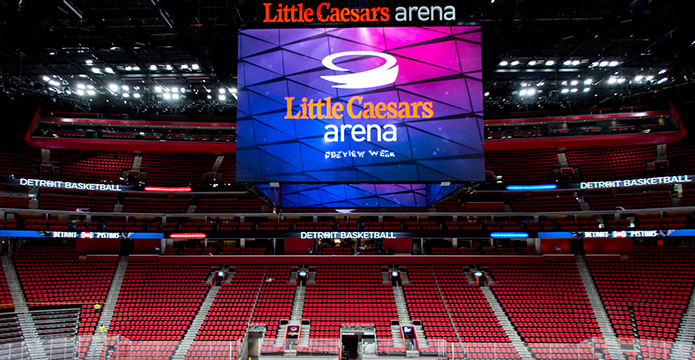
At Little Caesars Arena, you’ll have an immediate sense that the venue has earned its reputation as one of North America’s finest entertainment venues for good reason. The facility’s construction cost around $862 million when it went up in place of the Joe Louis Arena and The Palace of Auburn Hills. Since then, the arena has served as the official home for the NHL’s Detroit Red Wings and the NBA’s Detroit Pistons, bringing professional sports back to downtown Detroit in a big way.
The venue hosts more than 200 events annually, ranging from concerts by international superstars to family shows and comedy performances. You’ll find yourself in a facility designed by HOK architects, featuring a unique eight-story bowl structure with its floor 40 feet below street level. This innovative design creates exceptional sightlines from virtually every seat.
The arena has received SAFETY Act Certification from the Department of Homeland Security, and at the time, it was one of the only arenas in the United States with this designation. You can attend events with confidence knowing that comprehensive security measures will be in place to protect your safety without compromising your experience.
Distinctive Features and Popular Amenities at the Arena
Visiting Little Caesars Arena puts you in touch with comprehensive amenities designed for your comfort and convenience. Here are some of the most notable features you can enjoy:
- State-of-the-art technology, including one of the largest videoboards in existence and more than a thousand display screens.
- Several full-service restaurants, including Mike’s Pizza Bar and PointsBet Sports Bar.
- Convenient cashless operations, with Reverse ATM kiosks to convert cash to prepaid cards.
- Sensory-inclusive features, such as KultureCity’s sensory bags with noise-canceling headphones and fidget tools.
- Advanced Wi-Fi connectivity, giving you free high-speed internet in the arena.
As you look around the arena, you’ll see features like the gondola seating, suspended above the stands to offer guests a unique vantage point (only for select events). You’ll also notice Delaware North Detroit SportService serving as one of the arena’s official concessionaires, which ensures you have access to quality food and beverage options throughout the arena. These stands offer everything from traditional arena fare to upscale dining, a great reflection of Detroit’s diverse culinary landscape.
Lastly, you won’t want to miss the Via concourse, an atrium that stands around 80 feet tall. Protected by a beautiful glass roof, this walkway connects the arena to the surrounding offices and retail spaces. Essentially, this is like an indoor street, but one that remains open year-round, even on non-event days, to create a worthy destination in itself.
Some Venue History Behind Little Caesars Arena
The journey of Little Caesars Arena began in 2012 when the Ilitch family announced plans for a new downtown arena. Construction broke ground in September 2014, and the facility officially opened its doors on September 5, 2017.
Today, you’re experiencing a venue that represents the largest construction project in Detroit’s modern history. It served as the anchor for The District Detroit development and has grown from strength to strength over the years.
Originally, the arena opened with Kid Rock concerts, celebrating the Michigan native while establishing the venue as a premier concert destination. Soon after, the Detroit Red Wings played their first game, facing the Boston Bruins in a preseason matchup. The Detroit Pistons followed, debuting at the venue on October 4, 2017, against the Charlotte Hornets.
The sports lineup was particularly beneficial, marking a historic moment for Detroit sports. For the first time since 1974, the arena managed to bring back all four major professional sports teams to the city limits, as fans, local businesses, and the sports industry celebrated.
Detroit’s Amazing Transformation Alongside the Arena
If you’re heading to Little Caesars Arena, you’ll be attending events at a venue that has already hosted countless memorable moments in its relatively short history. It’s still a key player in one of the most remarkable urban comebacks in American history.
The venue’s opening in 2017 coincided with Detroit’s dramatic recovery from its 2013 bankruptcy, the largest known municipal bankruptcy filing in U.S. history at the time. Some estimates indicated that the city carried $18 billion in debt, around 20% unemployment, and entire neighborhoods as ghost towns when tens of thousands abandoned their homes.
When the arena appeared on the landscape, it instantly became a symbol of Detroit’s resilience and transformation. The venue didn’t just replace older sports facilities; it catalyzed a broader revitalization that has reshaped downtown Detroit entirely. The project created over 12,000 jobs and intentionally awarded the lion’s share of its construction contracts to Detroit-based operators, pumping hundreds of millions into the local economy.
Notable Political and Economic Changes That Shaped the Era
This massive arena’s development coincided with a pivotal period of political and economic transformation in Detroit, from 2013 through 2015. Emergency manager Kevyn Orr oversaw Detroit’s bankruptcy proceedings while Little Caesars Arena planning continued. His “grand bargain” then secured the financial contributions it needed from donors and the government to protect the Detroit Institute of Arts.
In January 2014, Mayor Mike Duggan took office in Detroit. From 2014 through 2025, the city under Duggan’s leadership has achieved at least 10 consecutive years of balanced budgets, helping its income tax revenue grow exponentially in that time. Detroit even built a $550 million reserve fund, pushing it out of its junk status to investment-grade ratings.
The city has since recorded its lowest homicide rate since 1965 and its lowest unemployment rate on record, and its population has begun to grow again. As of January 2026, Mary Sheffield won Detroit’s 2025 mayoral election and inherited the dramatically improved constituency. Little Caesars Arena continues to be a beacon of hope in this new space and continues to keep up with the area’s development stride for stride.
The District Detroit’s Promises and Progress
You’re visiting an arena that wasn’t just an entertainment destination. Those who envisioned Little Caesars Arena meant it as an anchor for a $2.1-billion, 650,000-square-foot project: The District Detroit.
The original vision included residential units, retail outlets, office space, and hotels around the central arena. Progress has been slower than initially projected, but the ongoing developments are undeniable. The community has seen the emergence of the Mike Ilitch School of Business at Wayne State University, Little Caesars Arena world headquarters expansion across from Comerica Park, Google’s regional sales office relocation to the venue, and the former Eddystone Hotel’s historic renovation.
In the next few years, there are plans to revise six new and four renovated buildings, break ground on a 261-unit residential building, and begin a hotel development adjacent to the arena. The historic apartment renovations on Henry Street also aim to create more affordable housing in The District Detroit, giving more people access to employment within this central economic hub.
Little Caesars Arena’s Many Improvements and the Area’s Modernization Plans
While bearing witness to the continuous development around it, the arena itself has not remained static. In January 2025, the Detroit Red Wings announced a major multi-phase renovation project aimed at cementing the arena’s status as a premier venue in the U.S.
You’re also benefiting from:
- » The installation of a new goal horn in 2023 that uses compressed air, not nitrogen
- » Several upgraded luxury suites and premium seating areas
- » Continuously expanded food and beverage options from local Detroit restaurants and vendors
- » Creatively reimagined exterior plaza spaces that aim to foster community engagement
Past improvements at the arena have also included a seat replacement project that converted red seats to black to reduce the appearance of empty seats during games.
In all of this, Little Caesars Arena has been at the heart of downtown Detroit, which has itself experienced a remarkable transformation. In an era of unprecedented progress, downtown Detroit has featured 54 development projects and has another 20 in the pipeline. Examples include Hudson’s Detroit, a 49-story mixed-use tower and Michigan’s second-tallest building, The University of Michigan Center for Innovation, the Ralph C. Wilson Centennial Park, a new 22-acre riverfront, and the renovation of Michigan Central Station by Ford Motor Company.
Setting Milestones and Overcoming Challenges for Little Caesars Arena
The Little Caesars Arena’s development hasn’t been without controversy. The venue received more than $400 million in public subsidies, sparking debates about public funding priorities when many residents faced economic turmoil in Detroit. Critics noted that much of Detroit’s visible revival has concentrated in downtown and Midtown areas, while the outer neighborhoods still struggle.
The promised District Detroit development has also faced repeated delays for several years. However, supporters still point to the arena’s role in bringing Detroit’s four major sports teams downtown, creating thousands of jobs, and contributing to the city’s overall economic resurgence.
It’s true that Little Caesars Arena has welcomed some of the biggest names in entertainment since opening, including major artists like Elton John, Foo Fighters, and Guns N’ Roses. You regularly have access to popular touring acts, ensuring world-class entertainment at your fingertips in central Detroit. Besides music, the arena’s numerous playoff games for the Red Wings and Pistons showcase Detroit’s passionate sports culture and thrive on events like UFC 218, the 2022 NCAA Division I Wrestling Championships, the 2019 U.S. Figure Skating Championships, and NCAA basketball tournament games.
With such a rich history in such a short time, it’s amazing to see how the venue has already become synonymous with memorable sporting moments and championship aspirations. As you walk in and experience it for yourself, don’t forget that the arena has served as a cornerstone of Detroit’s dramatic comeback story. It’s changing the future one glorious event at a time, and you get to be a part of that journey.
For parking information please see the parking page.
For ticket and ticket marketplace information please see the Little Caesars Arena tickets page.
To see the seating chart and find out about accessible seating, please see the Seating Chart page.